

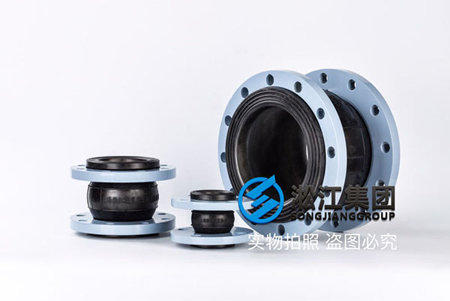
The official website of Shanghai Songjiang Group introduces relevant information about NBR rubber joints for use in high-speed wire rod rolling mill thin oil lubrication stations. Shanghai Songjiang Group provides high-quality NBR oil-resistant rubber joints tailored to numerous high-speed wire rod rolling mill thin oil lubrication stations.
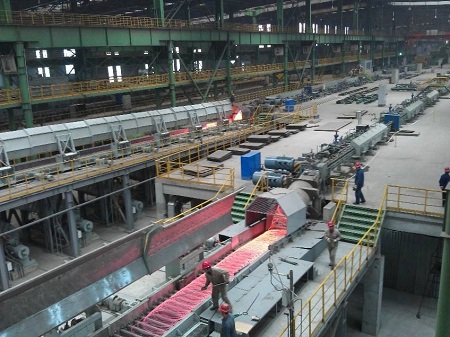
As the rolling speed of the mill continues to increase, higher demands are placed on the lubrication system. Moreover, with the development of science and technology, new technologies and methods are continuously applied to the control of thin oil lubrication systems.
High-speed wire rod refers to wire steel produced by a high-speed rolling mill, which can be divided into threaded steel and coiled round steel. Some coiled round steel, depending on the type of rolling mill, is further categorized into high-speed wire rod (high wire) and ordinary wire rod (ordinary wire).
High wire is produced by a “high-speed no-twist rolling mill” with a rolling speed ranging from 80 to 160 meters per second. Each coil weighs between 1.8 and 2.5 tons, with high dimensional accuracy (up to 0.02mm). The production process allows for the adjustment of process parameters, especially on the cooling line, to meet different product requirements.
Ordinary wire, on the other hand, is produced by an “ordinary rolling mill (usually a cross-rolling mill)” with a rolling speed of 20 to 60 meters per second. Each coil weighs between 0.4 and 0.6 tons. During the rolling process, product performance is ensured only by air cooling or natural cooling on the cooling line. Ordinary wire is characterized by smaller coil weights, typically packaged in several segments per bundle, with looser and more disorderly packaging.
Precision rolling mill units are utilized in high-speed wire rod workshops, typically consisting of four mills, all of which are cantilever ring frame mills arranged alternately. Stand bushings are installed between the mills to achieve tension-free rolling.
These units are positioned either in the middle roller track of the roughing mill or behind the hot coil box. Equipment composition includes a front roller table for pre-cut flying shears, side guide plates for pre-cut flying shears, speed measurement devices for pre-cut flying shears, edge heaters, pre-cut flying shear and collection devices, scale removal boxes, front stand roller mills (FIE), precision rolling mills, stand bushing devices, inlet and outlet guide plates for precision rolling mills, dust removal devices, and roll changing devices, among others.
The precision rolling mill, being the finished rolling mill, is the core part of hot-rolled strip steel production. The quality level of rolled products primarily depends on the technical equipment and control level of the precision rolling mill. To achieve high-quality products, many new equipment, technologies, processes, and high-precision testing instruments are extensively used, including hot-rolled strip steel shape control equipment, fully hydraulic pressure-down devices, optimized shearing devices, and hot rolling oil lubrication technology. Additionally, dust removal devices are installed to protect equipment and the operating environment from pollution.
After being rough-rolled by the roughing mill, slab thickness typically ranges below 50mm, with some special products reaching up to 60mm. The head and tail parts of the slab exhibit varying degrees of irregular fish tails or tongues due to their free state at the head and tail ends. To prevent steel broom accidents during threading through the precision rolling mill or entering the coiler, and to avoid roll marks caused by low head and tail temperatures, the head and tail of the slab are sheared by 100 to 150mm using pre-cut flying shears. The sheared slab then undergoes scale removal using high-pressure water of 15.0 to 17.0MPa, before entering the precision rolling mill to be rolled into the required strip steel size.
For some special varieties, such as silicon steel, stainless steel, and cold-rolled deep-drawing steel, the edges of the slab are typically heated before entering the precision rolling mill to ensure uniform temperature distribution across the cross-section, thereby obtaining strip steel with completely consistent metallographic structure and properties, while also preventing edge cracking and serious uneven density loss caused by low edge temperatures.
Songjiang NBR Rubber Expansion Joints for High-Speed Wire Rod Rolling Mill Thin Oil Lubrication Stations.
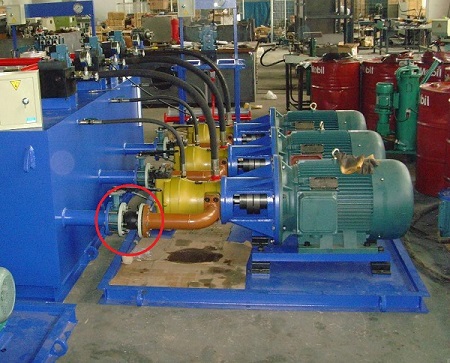
The thin oil station is crucial for ensuring the normal operation of equipment such as blowers. Serious leakage during operation can lead to significant losses for executive components and even cause major shutdown accidents. Even minor leakage can have adverse effects on the on-site environment and safety production. Traditional methods require disassembly for maintenance, which is not only labor-intensive but also leads to long downtime, severely affecting continuous production. High-polymer composite materials can be used for rapid on-site treatment, demonstrating characteristics of quick, convenient, and durable repair, allowing for leak remediation without or with minimal downtime.