

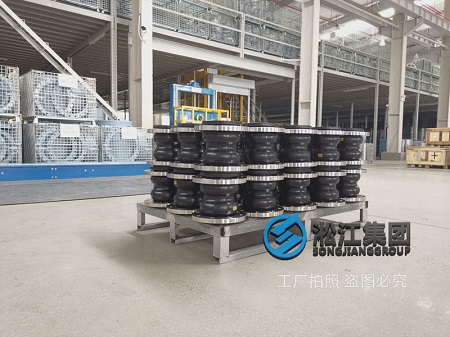
Shanghai Songjiang Group’s official website introduces: Optimizing Continuous Casting: Essential Elements of a Quality Crystallizer. Songjiang Group provides high-quality rubber expansion joints and high-frequency vibration rubber expansion joints with a pressure resistance of PN20 for many steel plant crystallizers.

A continuous casting machine is a device used for continuously casting metal ingots, typically employed in the production of sheet metal, bars, and other products made of steel, aluminum, and other metals. Its primary working principle involves pouring molten metal into the crystallizer within the continuous casting machine through a pouring spout. The cooling water inside the crystallizer rapidly solidifies the metal into ingots, which undergo a series of stretching, shaping, and cooling processes to eventually yield finished products.
The crystallizer is a crucial component of the continuous casting machine, with the following main construction and functions:
The crystallizer is typically a trough-shaped container without a bottom plate, known as a bottomless crystallizer. Its side walls are usually made of materials resistant to high temperatures and corrosion to withstand the pressure of the molten metal and the friction generated when the metal flows. Inside the crystallizer, there are a series of water-cooled jackets or serpentines designed to rapidly cool the metal by water cooling and solidify it into ingots. Additionally, the crystallizer is usually equipped with an agitating device to ensure the uniform solidification and structure of the metal ingots.
The crystallizer plays a crucial role in the continuous casting machine. Through the rapid cooling action of the cooling water, it facilitates the quick solidification of molten metal into ingots while maintaining the shape and size stability of the ingots. The crystallizer also adjusts the metal’s crystalline structure and grain size, thereby influencing the performance and quality of the final products. Moreover, the crystallizer ensures uniform solidification of the metal to prevent defects and uneven internal structures in the ingots.
For qualified cast ingots, the crystallizer should meet the following basic requirements:
- Excellent thermal conductivity to facilitate rapid solidification of molten steel in industrial processes.
- Good wear resistance to extend the crystallizer’s lifespan, reduce maintenance workload and replacement time, and improve the operating efficiency of the continuous casting machine.
- Sufficient rigidity, especially in situations with significant temperature gradients, to minimize deformation.
- Simple and compact structure for ease of manufacturing, assembly, and adjustment, with convenient disassembly and self-connecting cooling water circuits for quick replacement.